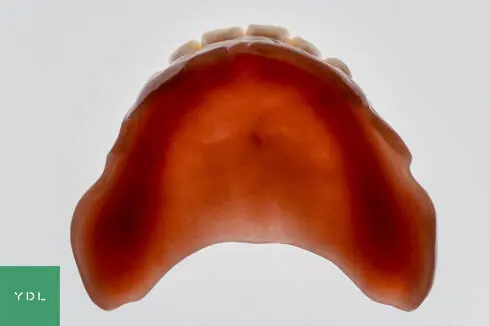
The complete denture
We all like predictability. When it comes to the success of our work, certainly. I have not yet met a dental technician who was happy to work on a case whose final success they were not convinced of. I am sure that on the clinician's side a job with a doubtful outcome is met with similar enthusiasm. Nobody wants the patient to have to leave the practice dissatisfied.
Unfortunately, with removable complete dentures we often encounter ad hoc solutions and improvisation from both sides, which can lead to failure. After a few unsuccessful cases we may even begin to question our own expertise in this area. At the same time we are all failure-averse. Perhaps this is also the reason why we try to reduce this kind of treatment to a minimum.
What makes a complete denture unsuccessful?
Let us try to describe this from the patient's side first. What are the factors that can cause disappointment in the patient after a denture is delivered, or even lead them to reject it:
poor fit
the bite height is not right
the denture is not stable
wearing it causes pain
speech problems
difficulties eating
biting the tongue or the cheek
aesthetic dissatisfaction
If a new denture does not deliver the result the patient expected in advance, this situation can quickly lead to a loss of trust.
I believe that all these expectations can be met! At the same time it is important to keep them in check and to be realistic. There are extreme and particularly difficult situations and challenges; in these cases the preliminary consultation should be given particular emphasis. It is important that the patient understands and accepts that wearing and using a denture requires habituation and adaptation on their part, which takes time.
Two frequent errors arising from mistaken expectations:
we produce the device used for determining the centric relation already from the anatomical impression — its base plate will certainly not fit the functional model properly, so we cannot mount the centric relation in the articulator correctly, and consequently the try-in will certainly be faulty
From the practice's side it seems understandable at first to carry out the functional impression and the recording of the centric relation in one appointment, since this would save significant treatment time and the patient would need one appointment fewer. However, even if this is done correctly in the practice, the poorly fitting base plate makes it impossible to produce a correct trial denture in the laboratory.
we change the Angle classification of the patient's original tooth positions — for example Angle class III: prognathism. The triple unit of the teeth is displaced by one tooth width compared to class I (normal occlusion). If we try to correct this in the case of a complete denture, it will certainly be at the expense of stability
It may be an excessive expectation on the patient's part that we should correct the position of their original teeth and eliminate the prognathism. Breaking the rules of biomechanics would lead to an unusable denture. This does not mean, however, that the end result cannot be functional, aesthetic and individual in appearance at the same time.
What are the fundamental pillars on which we can create a comfortable, stable, functional and aesthetic restoration?
The finished denture working in harmony with the soft tissues and the muscles
Correct recording of the bite height
Correct recording of the jaw relation
The accuracy of the occlusion
1. Harmony with the soft tissues and muscles
The conditions for correct extension of the base plate are determined by the functional impression.
Making a complete denture always begins with examining the structures of the oral cavity in the practice. It is important that the impressions and information gained here (for example the quality of the mucosa) are passed on to the laboratory. These can influence even the making of the custom tray.
The more important anatomical structures on the jaws that influence the extension and stability of the denture:
Upper:
alveolar ridge
tuber alveolare maxillae
pterygomandibular fold
frenula
blow line
Lower:
alveolar ridge
frenula
retromolar area
buccinator pouch
The purpose of the model made from the overextended anatomical impression is that a custom tray for the definitive impression can be made on it. There are basic professional requirements for the extension of the tray; however, it is worth discussing this according to the prosthetic system used, the quality of the mucosa and the impression material. It is always advisable to correct and border-mould the edge of the tray in the practice. The definitive denture has to reproduce the form of the edge of the impression taken with a correctly border-moulded tray. When pouring functional impressions it is important to preserve the edge of the functional sulcus and, where possible, the parts above it as well, for shaping the base plate. By consistently keeping to these steps we can ensure a valve-like seal of the base plate.
2. Correct recording of the bite height
3. Correct recording of the jaw relation
The two most widespread ways of determining the centric relation in edentulous jaws:
Bite rim
Wax rims placed on a base plate, which we fix to each other in the centric relation position.
From the laboratory's side:
The base plate has to remain stable during the try-in, so appropriate extension is important. An accurate base plate can only be made on a functional model.
Take anatomical considerations into account when shaping the wax rims as well! For example, the average intervestibular distance is 36–40 mm between the lower and upper fornix.
From the practice's side:
Before the try-in, check the seating and stability of the base plate. Correct it if necessary.
Since the wax rims were made on the basis of average values, they have to be trimmed according to the patient's characteristics and the height adjusted. The upper rim will determine the spatial position of the anterior teeth, and this has to be corrected accordingly as well.
It is worth shaping the wax rims precisely according to the centric relation, so that we can record it in a resting position.
After recording, marks made on the vestibular surface of the wax rims greatly help the correct setup of the artificial teeth: midline, smile line, ala line, occlusal plane. A facial photograph taken with the rims in place can also be of great help to the laboratory.
It is a frequent phenomenon that at the next try-in the teeth contact earlier on one side. This is most often caused by the wax rims not contacting evenly during the try-in: on closing, one base plate imperceptibly shifts and tips during the try-in, and is recorded in that position.
Another frequent problem is that the wax rims are recorded in a protrusive position. The result of this will also be an incorrect position of the artificial teeth in the trial denture.
2. Intraoral central bearing pin registration
The centric relation is recorded with the help of a stylus fixed to one base plate and a registration plate fixed to the opposing base plate.
From the laboratory's side:
In this case, too, the base plate has to remain stable throughout the try-in, so appropriate extension is important
The stylus and the registration unit have to be positioned so that they do not create a tipping effect during registration
For the two plates to be parallel with each other and at the appropriate height, we need a previously recorded jaw relation
From the practice's side:
In this case, too, we have to ensure the seating of the base plates
With the help of the bearing pin we can set the appropriate physical bite height. The only contact point between the two plates is the tip of the stylus
We colour the registration plate so that the movement of the stylus becomes visible on it
Keeping them in contact throughout, we have the patient make various movements, so that a tracing is created on the registration plate (an arrow point or triangle form)
The patient's centric relation position is found at its apex
We fix a perforated acrylic plate to this point, which when closed prevents displacement of the jaws. In this position we can then easily record the centric relation.
This method practically excludes every possibility of error in determining the vertical and horizontal position of the jaw relations, while it is easy to carry out and does not take much time. Nor is there any need for the clinician to carry out work of a dental-laboratory nature in the meantime, as when trimming wax rims.
In general it can be said that here, too, both methods can lead to a good result if we apply them with sufficient care.
4. The accuracy of the occlusion
Mount the models in the articulator at true average values (in the absence of a facebow registration)!
Several methods are known for setting up the artificial teeth, but model analysis always precedes it. With its help we can determine the aesthetic and functional zones, the masticatory centre and the stop point, and we can decide whether the molars need to be set up in crossbite.
The lower anterior teeth and the central fissures of the molars are placed exactly towards the middle of the ridge, and we no longer set teeth behind the stop line. Anterior and canine guidance is to be avoided; we have to aim for a balanced occlusion. This is essential from the point of view of the stability of the denture.
After the tooth setup we model the definitive form of the base plate in wax in such a way that the muscles surrounding it can help it stay in place as much as possible during use, and we also take later cleanability into account.
If the trial denture proves adequate from both a functional and an aesthetic point of view, then we have nothing else to do but process it into its final form. It is important to check the occlusion in the articulator after processing, and to carry out corrective grinding if necessary.
As with every restoration, a predictable, reliable end result is important to us with a denture as well. This is why it is important to work according to a proven, well-considered system. It is true of every restoration that the most expensive work is the one we have to do twice, whether that is an impression or a new try-in. Working within a good system we can reduce these to a minimum and keep the number of treatments and working hours within sensible limits, while still providing a good-quality service.
Why should we give that up in the case of a denture?