The right shade of a restoration is one of the cornerstones of patient satisfaction.
Determining the shade of natural teeth can often be a challenge. For the clinician to communicate the desired shade properly, they have to know the characteristics of natural teeth and the science of colour.
At the same time, the dental technician has to be able to interpret these shades and reproduce them by selecting the appropriate materials. Only in this way can the restoration be as natural as possible and blend in with the remaining dentition.
What does this mean in practice?
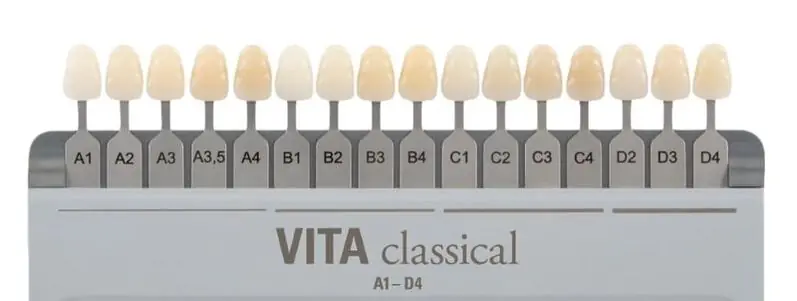
For communication we traditionally use shade guides. The most widespread of these is the VITA classical A1–D4 shade guide.
On it we distinguish 4 colour groups (HUE):
A - reddish-brownish
B - reddish-yellowish
C - greyish
D - reddish-grey
The intensity of the shades (CHROMA) is indicated with numbers. As intensity increases, lightness decreases.
According to lightness values (VALUE) we get the following order:
Natural midday light is the most ideal for shade selection. Of course it is not always possible to select a shade at that time, so we should aim to use artificial lighting that resembles natural daylight. In this way we can ensure that we carry out this working phase under consistent conditions.
Before shade selection the surrounding colours have to be neutralised! Colourful clothing or lipstick influence our colour perception.
The selection has to be quick! Beyond 5 seconds our perception deteriorates. In addition we have to avoid dehydration of the teeth. The shade intensity of dried-out teeth decreases and their lightness value increases.
To determine the shade, use the middle of the tooth! The canine is the most ideal for selecting the shade.
The shade guide should be positioned in the same plane as the remaining tooth, with their incisal edges facing each other!
Frequent mistakes in clinic–dental laboratory communication:
There can be differences between the shades of shade guides from different manufacturers. It is important that the laboratory and the practice use the same type!
For monolithic restorations always use the classical shade guide! A frequent mistake is using the 3D shade guide in such cases, because these materials are only available in the shades of the classical scale.
Photographs without a shade guide are of very little practical use. Under different lighting conditions and depending on the camera settings, the same tooth can be photographed in countless shades. This is why the shade guide is important as a reference.