The importance of model fabrication
Every conventional dental laboratory job begins with making stone models.
To produce a restoration we need at minimum a working model and an antagonist model, and we have to be able to determine their relationship to each other, that is, the centric relation.
Depending on the type of restoration we use working, antagonist, study, functional, anatomical and second models, and so on.
Since their quality irrevocably determines the success of our later work, they must in any case meet a few minimum requirements:
1: they should be dimensionally accurate and free of distortion
2: they should be sufficiently hard, and should not break or crumble at least until the restoration is finished
3: they should be mountable in an articulator accurately
How can we achieve this?
1: By using appropriate materials
2: By using the materials according to specification and accurately
3: With a precise model system
1 Appropriate materials:
For making restorations almost everyone now uses class IV (so-called super hard) stone, as these can meet the requirements. The two most important properties of these stones:
Brinell hardness (2 hours after mixing): approximately 250–310 MPa depending on type.
(For a class III stone this is approximately 100 MPa. Class III stones are generally used for antagonist models.)
Setting expansion: 0.08–0.10% — this indicates the expansion that takes place while the stone sets. It does not seem significant, but with a larger bridge restoration, for example, we can already experience problems if we do not compensate for it.
The values given by the manufacturer can only be achieved with correct use!
2 Using the stone:
mix dental stone only with distilled water
mix a maximum of 300 g of stone at a time; this is important for correct crystallisation
keep to the prescribed powder/liquid ratio — the more water we mix into the stone, the lower the final hardness will be. Measuring these accurately is therefore essential.
Expansion is greater with hand mixing; the manufacturer's expansion value can only be achieved with vacuum mixing
mixing time also influences expansion
If we do not keep to the manufacturer's specifications and the basic rules, this has an unfavourable effect on every important property of our model. But if the stone expands while setting, we have to do something about that on top of everything else!
3 — Model system
Since our aim is to make a dimensionally accurate model, we have to eliminate the setting expansion of the stone somehow. The most precise solution available today for this is a plastic-based model system, which Zeiser Dentalgeräte GmbH has been developing since 1980 and which reached its present form in 2007. Since then several others have copied it, but the principle and the end result are the same.
How the Zeiser system works:
We fix the impression in the impression holder and ensure an even thickness of stone later on.
We fit the impression holder onto the auxiliary base, exactly above the plastic base.
With the help of a laser beam we drill holes at the areas to be sectioned.
We place the brass pins into the holes.
We pour the impression, then turn the plastic base with the pins onto it.
After a minimum of 30 minutes of setting we separate the impression, then remove the stone model from the plastic base. Expansion has already begun by this point, so the model can no longer be placed back onto the base in one piece — the pins bind.
We trim the model, then section the dies.
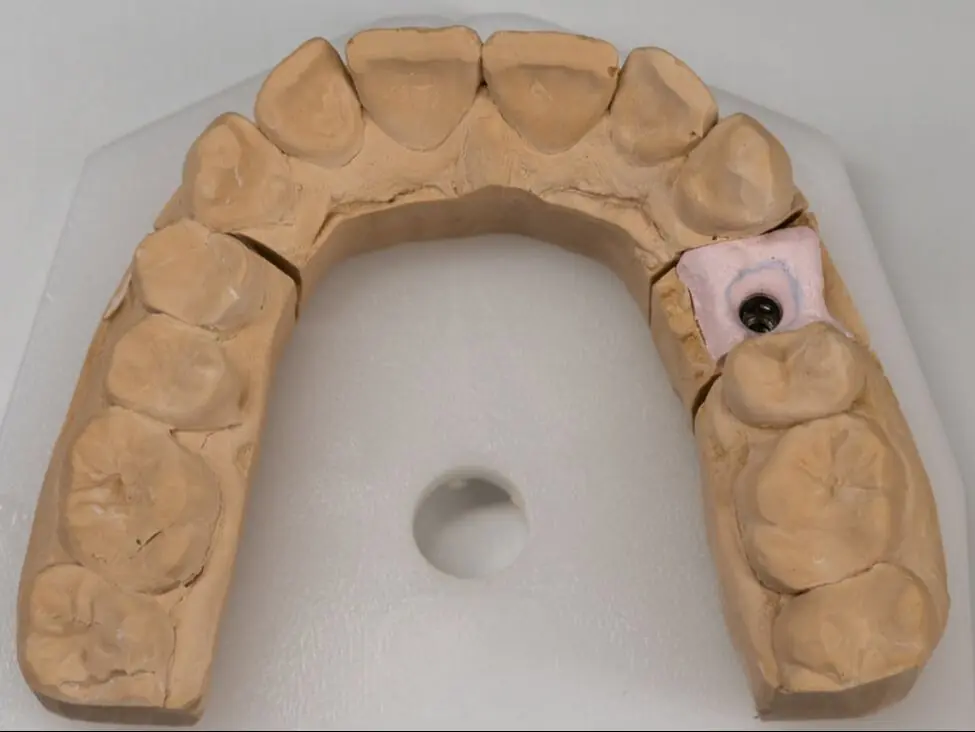
After cleaning and drying, the individual segments can be placed back onto the plastic base accurately. With this we eliminate the expansion of the stone along the arch and can provide a precise basis for a perfectly fitting restoration.
With the help of the articulation bases we can carry out mounting precisely and elegantly.
To sum up, even a workflow that seems as simple as making a dental laboratory model holds many pitfalls and tasks to be solved if we want to do it properly. Its execution requires professional preparedness and humility alongside the right technical background and materials. Without these we deprive ourselves, right at the start of the workflow, of the chance to produce a truly successful restoration.