Gold onlay with CAD/Cast technique
Despite the fact that we are aware of their durability, gold-based restorations are increasingly pushed into the background. The reason for this is primarily the extremely high price of gold alloys. Precisely for this reason, precise and well-plannable execution is decisive for such a restoration. Through making an onlay we show how, with the help of technology, we can work economically with precious metals.
Initial situation:
We are planning to replace the onlay on the lower left first molar.
Analogue steps:
The preparation was carried out accordingly. From the impression we made a sectioned model and a second model.
Digital steps:
(CAD)
Then, instead of conventional wax modelling, scanning of the model and digital design of the onlay followed. This gave us the opportunity to determine the future weight of the onlay precisely, on the basis of the specific gravity of the alloy.
The material:
The choice of alloy also served cost efficiency: instead of the conventional inlay/onlay gold alloys (>80% Au) we chose a reduced-gold-content gold–silver alloy (55% Au – 30% Ag). Its greatest advantage was its lower specific gravity. In this case we saved exactly 1 g of precious metal because of it.
(CAM)
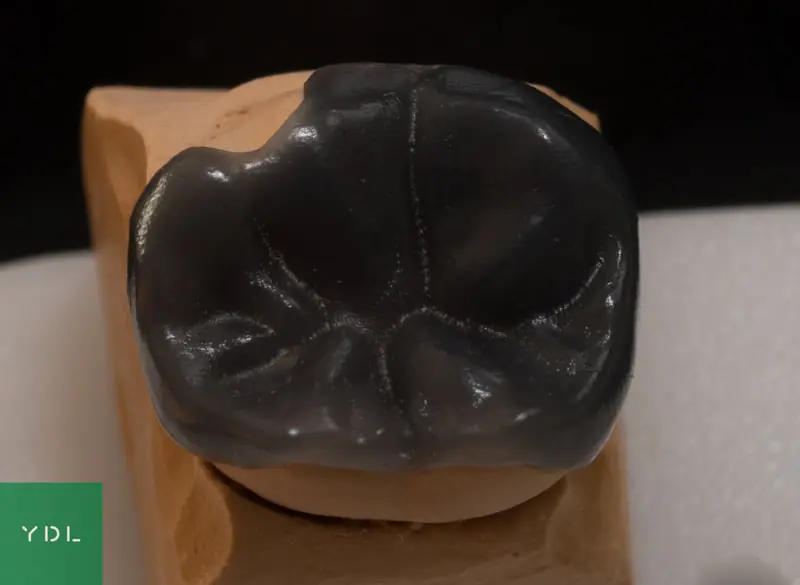
Then we milled the design from wax, which is likewise a computer-controlled process. The fit could then be checked on the model in the conventional way. Thanks to the precise manufacturing, no modification was needed.
Analogue steps:
Sprueing and casting followed, in the usual way.
Milled wax behaves in the same way as conventional wax, so we did not have to change the well-proven investment procedure.
After casting, the onlay fitted the model well.
The contact points were slightly overdimensioned, as designed.
After polishing the mesial and distal areas it can be seen that the occlusal contacts are ideally positioned, on the marginal ridge and at the cusp–fossa contacts.
Finishing and polishing were carried out in the well-proven way.
The restoration was then ready for cementation.
The new onlay after delivery:
By using analogue and digital technology together, in the case of a precious metal restoration we can determine the weight of the alloy to be used precisely, so we can calculate the final price before manufacturing. Not incidentally, this is the most precise and therefore the most economical way of using alloys.
Dental work: dr. Molnár Bertold